


There is a line you hear everywhere now.
“In the age of AI, taste and judgment are what matter.”
The reasoning goes: machines can produce anything now, so the human edge is knowing what is worth producing. You hear it at conferences, in articles, in threads on X, in the YouTube videos and slide decks of people who want to seem ahead of the curve.
It is about half right. And the wrong half is the half everyone keeps.
Because taste did not suddenly become scarce. Taste was always scarce. It — along with judgment — was always the thing that separated the good from the bad.
The Pulitzers from the paperbacks.
Back when writers were pushing pen on paper to get a manuscript out.
What AI did was strip away everything that used to be scarce around production of knowledge work: the hours, the skill, the cost of producing. And once all of that fell away, taste was left standing alone in the open — suddenly, obviously visible.
We created a narrative for its arrival.
But the tide going out does not put the rocks there. It only lets you see them.
Let’s start at what got better
AI genuinely makes the production of knowledge work easy. Not a little easier — categorically easier.
I have built more in the last couple of years than in the fifteen before them. Websites, agents, small tools, automations, SOPs, frameworks. Frankly, it was giddy at times. The building was so effortless that you start making more work simply because — why not? When something that used to take months of toil takes an afternoon, the whole calculus of what’s worth doing shifts beneath you.
This part is real. Anyone telling you the productivity gains are hype has not actually used the tools.
And here is the second thing.
People will adopt this. But adoption in this case is not strictly evidence of economic value — it’s more so an evidence of effort avoided. People reach for whatever makes hard things easy, and they do it whether or not it creates immediate economic value for them.
This matters because media and experts treat usage as ROI. More adoption means more economic value creation, but curiously in AI it does not work in that way. The value gets created for a platforms. Not for the user.
A lot of it, is work for the sake of work. Like I can vibe code a website- but that website does not automatically sell.
And that’s exactly what you’d expect, once you see what’s really driving the adoption.
Humans fundamentally do not want to do hard work. We are, sensibly, effort-minimising creatures. Anything that makes a hard thing easy gets adopted — fast, and without needing a business case to justify it. The drudgery of producing — the blank page, the boilerplate, the fortieth landing-page variant — is exactly the kind of pain people will pay to remove.
So when production gets cheap or easier, adoption is guaranteed for the tools that drive it.
And normally, that would be enough to celebrate.
Adoption usually is a signal of value — people adopt what helps them, and for most of history, saving effort was how value got created. Cheaper to make meant more margin, more output, more sold. The two moved together so reliably that we stopped distinguishing them.
But we should have.
Because the value never lived in production. It lived in creation — the whole act of deciding what was worth making, making it, and making it land. Production was only one part of that act. What made it feel valuable was that it came bundled with the rest: before AI, you could not produce the work without also doing the judging, the deciding, the caring. The effort of production dragged the rest along with it.
AI somehow severed that bundle. It made production easy and left creation exactly where it was. You can now produce endlessly without creating anything of value — because the part that was always hard, the part that was actually the point, was never the production.
It was always the taste and the judgement of creation.
The gap nobody is pricing
In the past two years I have built more than fifteen SaaS tools, more than twenty AI agents, and countless cool websites. They were fun to make. Almost none of them made any money or gathered any real momentum with users. Producing was never the bottleneck I was actually missing. What I was missing was the ability to create a solution to a problem that users were willing to pay for. Learning to vibe-code did not change that. It just made the producing easy and left the hard part exactly where it had always been.
That distance — between producing the thing and solving a problem someone will pay for — is the actual gap. It is what the productivity story cannot see, because it is measuring the wrong layer.
I call it the production–outcome gap.
It has two layers, and they used to look like one:
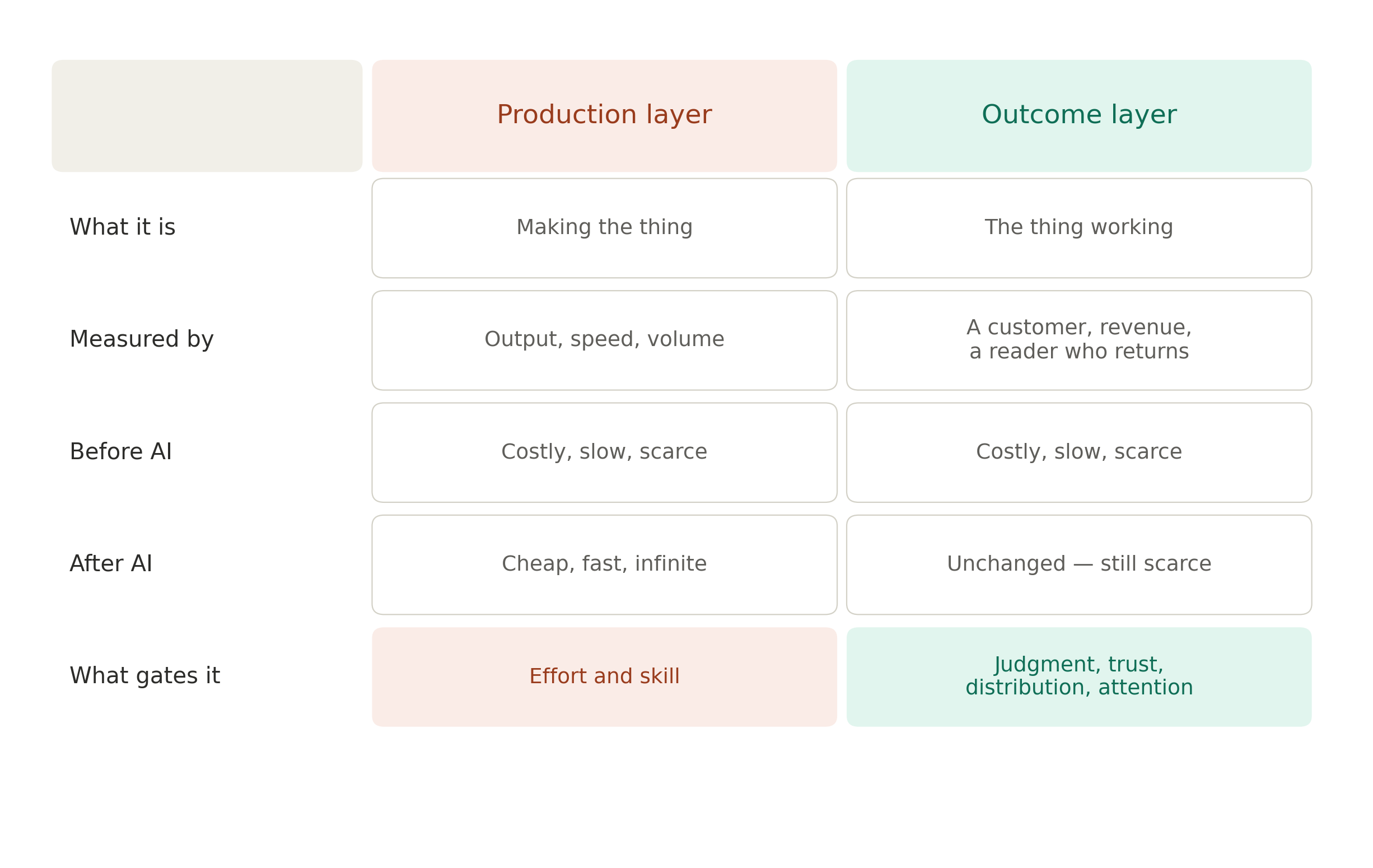
For most of history the two layers travelled together, and production cost was the reason. Effort acted as a filter. You did not write forty essays casually, so the ones you wrote tended to be the ones you believed in — which tended to be the better ones, which tended to be the ones that landed. Scarce production quietly tracked worthwhile output. We never saw the layers apart, so we never learned to tell them apart.
AI pried them apart in a single move. It collapsed the production layer but did not always add a monetisation angle to the outcome layer for the user. More tweets do not always buy you better followers. More landing pages do not summon more customers. More articles do not, by themselves, produce revenue. You can make ten times the work, and the work is no closer to doing its job — because its job was never to exist.
Its job was to land, and landing was always gated by the things in that bottom row: judgment, trust, distribution, attention. None of which AI can produce.
And here is the part that should worry you. The gap is not holding steady — it is widening.
When everyone’s production cost collapses at the same moment, every channel floods at once. The feed gets more crowded, the inbox fuller, the bar for attention higher. So cheap production does not merely leave the outcome layer untouched — it actively makes it harder, because the scarce resource on the far side, human attention, did not grow to match the supply.
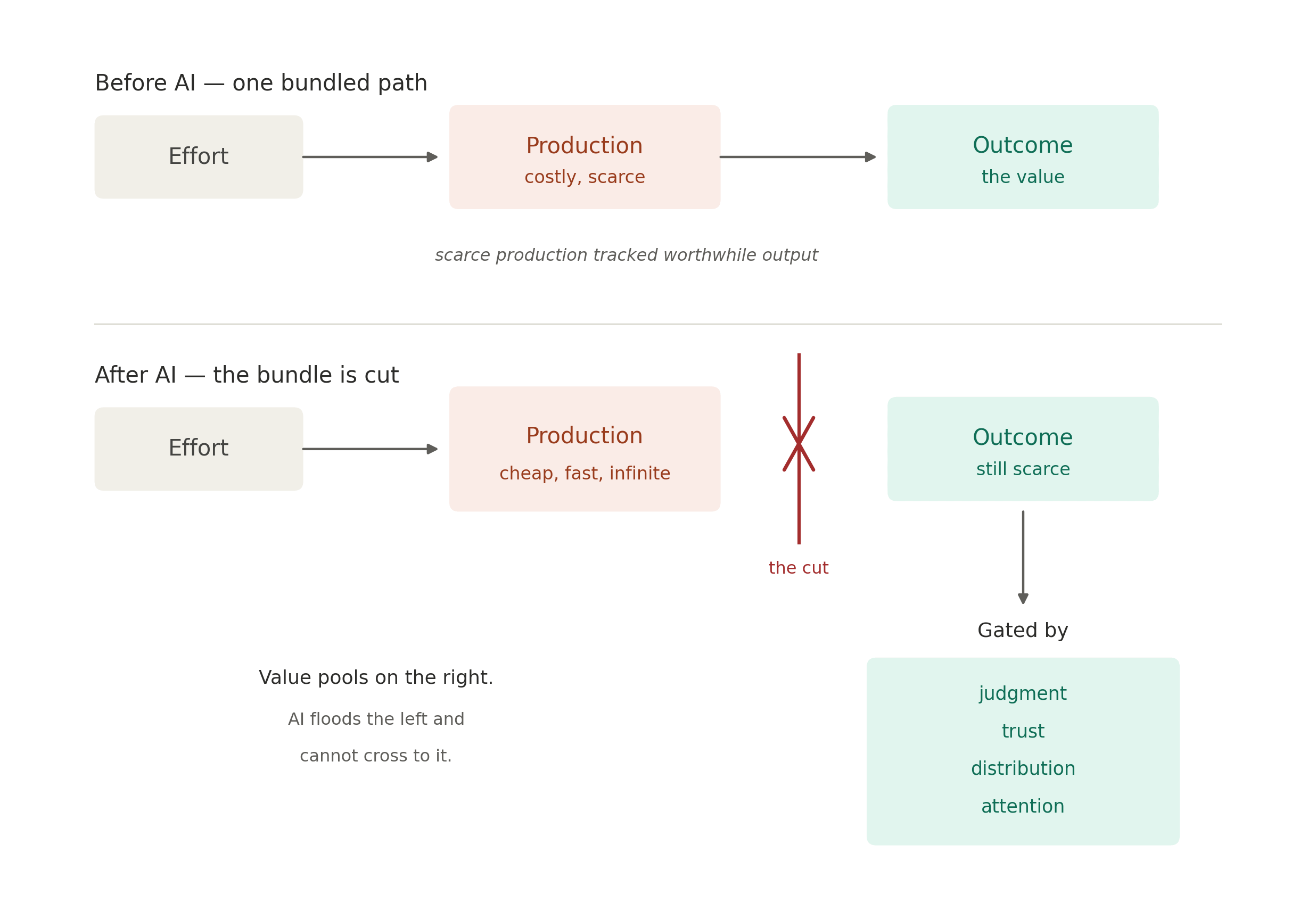
Abundance on one side. Fixed scarcity on the other. That is the production–outcome gap — and every tool that makes production easier pushes its two sides further apart.
The part that is about people, not throughput
There is a second reason adoption does not always readily convert into economic value — and it has nothing to do with throughput.
People are possessive about their work. Deeply.
Even a mediocre idea, if it is mine, I believe in it. It carries my authorship — and authorship is most of why people do knowledge work at all. We are not throughput machines reluctantly accepting tasks. We have ideas, including bad ones, and we are attached to them precisely because they are ours.
When AI writes the article, there is nothing to own. The sentence appears; no one authored it. A strange flatness sets in — the thing is done, but it is no one’s, and the satisfaction that used to come from having made it is simply gone.
This gets mistaken for a control problem: managers resisting because AI threatens their span of control. I don’t think that’s it. Control inside companies was always elusive — most of a company’s time goes into managing people, and much of the repeatable execution is outsourced anyway, to agencies if you are large, to freelancers if you are small. AI is just another layer in that stack.
The resistance is not about who controls the output. It is about who owns it — and ownership is identity, not org chart.
So adoption stalls, not because the tool is bad, but because it quietly removes the reason people were doing the work. They will happily use it to escape the drudgery they never wanted. They will not reach for it to do the part they were proud of.
And the part they were proud of was usually the part that determined the outcome.
What AI actually removed
For most of history, we have been able to hide. You could mistake being busy for being valuable, output for outcome, effort for results — because production cost money and time, and spending money and time felt like doing the thing that mattered.
The cost was an alibi. As long as making the work was hard, the hardness stood in for worth, and no one had to ask too sharply whether the work was any good, or whether it landed.
AI removed the alibi. It made production free — and in doing so, exposed the thing that was always doing the real work: judgment. Taste. Knowing what to make, and whether it will land. None of which was ever produced by effort or tools. They sit upstream of both.
This is why “AI makes taste matter” gets it backwards. Taste mattered the whole time. It is fundamental to who we are — the thing that was choosing, filtering, deciding, the whole time we thought we were just producing. AI did not promote taste to importance. It demoted everything around taste to free, and left taste standing in a clearing where you can finally see it.
So the real shift is not that we need a new skill for a new era. It is that the old skill can no longer pretend to be anything but itself. The work got easy. The thing that was always hard — knowing what is worth doing, and whether it worked — got harder to avoid.
That is the uncomfortable part, and the freeing part. There is nowhere left to hide. But there is also no longer any mistaking the question. You are not competing on how much you can produce. You never were. You are competing, as people always have, on taste — except now everyone can see the scoreboard more easily.